Organizational knowledge mapping for small nonprofits
Know what keeps your small nonprofit running.
tendry helps small nonprofits understand the systems they rely on, who owns them, how everything connects, and what needs attention before knowledge walks out the door.
$59 a month for your whole organization, or $599 a year. Cancel any time. You'll create an account, set up your organization, then start with a few plain questions — no demo call, no sales process. See what's included.
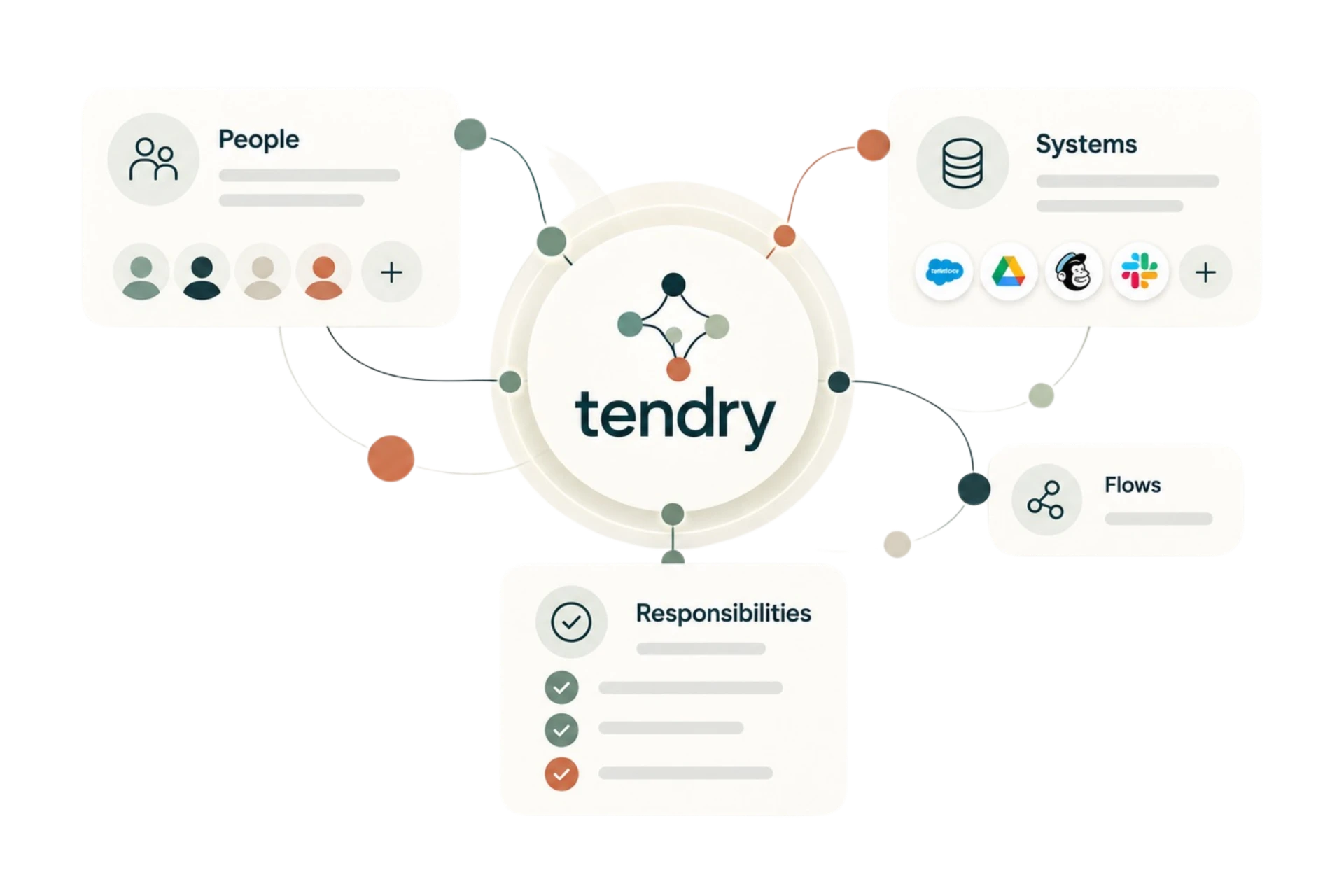
An illustrative example, not a real organization.
The problem usually isn't the software.
It's that no one has the whole picture.
- Your website was set up by one person.
- The board treasurer knows QuickBooks.
- A volunteer created the Mailchimp account.
- Someone else owns the domain.
- Nobody is completely sure how donations move from one place to another.

And eventually somebody leaves.
None of that means anything has gone wrong. It's what happens when a small organization grows one good decision at a time. tendry helps turn all of that scattered knowledge into a shared organizational picture.
How it works
tendry learns how your organization actually works.
You don't need to know what every tool is called or how everything connects before getting started.
- One
Tell tendry how things happen.
In your own words. tendry asks the kind of question a colleague would.
- "How can people donate?"
- "Where do you keep shared files?"
- "How do volunteers sign up?"
- Two
tendry builds the picture.
Your answers become a record your whole organization can see.
SystemsPeopleResponsibilitiesConnections - Three
See what depends on what.
The same information, read three different ways.
ResponsibilityMapFlows - Four
Know what deserves attention.
Improve surfaces a small number of useful next steps — and explains each one.
Responsibility
Know who holds what.
See who owns your essential systems, where backup coverage exists, and where important knowledge quietly depends on one person.
Responsibility
Givebutter
Jenny — System owner
— Marcus — Backup owner
QuickBooks
Steve — System owner
— No backup owner yet
Mailchimp
Jenny — System owner
— Transitioning out: Steve
Nothing urgent stands out in the rest of your systems.
An illustrative example, not a real organization.
Map
See how everything connects.
tendry turns scattered systems, methods and responsibilities into a visual picture of how your organization actually operates.
Givebutter
Donations — connected to Mailchimp and a spreadsheet
Mailchimp
Email — connected to QuickBooks
QuickBooks
Bookkeeping
Shared spreadsheet
A way of working, not a system
Paper sign-in sheet
A way of working, not a system
Jenny
Owns 2 of these
An illustrative example, not a real organization.
Flows
Understand what actually happens.
A donation comes in. Someone records it. Information moves somewhere else. tendry makes the everyday process visible — including the manual parts.
Automatic
Someone makes a donation
Givebutter
Automatic
Donor information recorded
Givebutter
Manual handoff
Jenny records it in QuickBooks
Typed in by hand
Still clarifying
Donor added to Mailchimp
Still clarifying how
Human action
Thank-you message sent
Written and sent by a person
Manual steps are simply named, never marked as mistakes. Plenty of them are exactly right.
An illustrative example, not a real organization.
Improve
Know what's worth doing next.
tendry doesn't give you twenty alerts or try to sell you more software. It surfaces the few things actually worth reviewing.
- Clarity before change.
- Fixing before buying.
- Improving before replacing.
Worth doing next
Fix
Reassign Steve's remaining responsibilities
Steve is no longer involved and still holds four current responsibilities.
Clarify
Clarify your Donation Flow
Three steps are marked still clarifying.
Simplify
Review the manual handoffs in volunteer signup
Two handoffs happen by hand. That may be completely intentional.
An illustrative example, not a real organization.
Who it's for
Built for organizations where everyone wears more than one hat.
tendry is built first for small nonprofits that have grown beyond one person being able to keep every system, vendor, responsibility and process in their head — but are still too small to have dedicated IT or operations support.

Executive Director
Holds the whole picture — and everything else
Staff
Owns the systems they use every day
Board Treasurer
Knows the finance side, and only that
Volunteer
Set something up once, years ago
Outside support
A designer, a bookkeeper, a past contractor

The systems matter.
The people who keep them working matter more.
Understand what you already have.
- No passwords stored.
- tendry tracks responsibility and access context — not passwords or secrets.
- No shame.
- “I'm not sure” is useful information. tendry helps you clarify over time.
- No software sales pitch.
- tendry recommends fewer problems, not more products.
- You stay in control.
- tendry can suggest and explain. Your organization confirms what is true.
Something to show
Proof that someone is minding the details.
Boards and funders ask the same questions every year: who has access to what, what happens if that person leaves, how do donations actually get recorded. With tendry you can answer them from one shared picture instead of from memory.
- Walk the board through your systems and who owns each one.
- Show the gaps you already know about — and what you're doing about them.
- Hand a new Executive Director something better than a folder and a phone call.
Your information
tendry stores your organizational map. Never your passwords.
Your data is encrypted in transit and at rest, kept separate from every other organization, and never sold or shared. You can export or delete everything at any time, and cancelling doesn't erase what you've built. Read the privacy policy.
tendry is built and run by Chris DenHerder at Connection Built, after years of hands-on work with small nonprofits. Who's behind tendry.
Your organization already runs on a system.
tendry helps you finally see it.
$59 a month or $599 a year. Cancel any time. Invited Pilot Partners can apply their code during signup.